

SS-31 and the Six Questions Worth Asking Before You Buy

Most guides to buying a peptide like SS-31 amount to an impression: this seller feels more legitimate than that one. A more useful approach is to write down exactly what “legitimate” should mean, check each seller against it, and see where the numbers land. That is the exercise here: six specific, verifiable criteria, scored against the common sources for SS-31, with the result laid out plainly rather than implied.
The spread is stark. The supervised medical channel clears all six criteria. The entire research-chemical tier, gray-market sellers of the same molecule under a “research use only” label, clears one. That single fact, six versus one, is the organizing idea of this piece, and it matters more than usual here because the underlying drug evidence for SS-31 is thin.
One more number belongs at the top, because it reframes everything that follows. In the largest human trial of SS-31 for the condition most people associate with it, primary mitochondrial myopathy, the drug did not beat placebo. A 24-week randomized trial in 218 adults found no significant difference from placebo on the six-minute walk test or on total fatigue, and it missed both its primary and secondary endpoints [P3]. When a compound’s efficacy case is this weak, sourcing quality stops being a tiebreaker between similar products and becomes most of what a buyer is actually paying for.
This piece links only to primary sources, never to anything being evaluated in the scorecard below.
The honest status, in three numbers
SS-31 is the laboratory name for elamipretide, a four-amino-acid peptide built to act on the inner mitochondrial membrane. Its regulatory and evidentiary status is easiest to hold as three separate numbers.
- One FDA approval, and a narrow one. In September 2025, the FDA granted accelerated approval to elamipretide, marketed as Forzinity, to improve muscle strength in patients with Barth syndrome who weigh at least 30 kg [P5][P6]. That covers one rare disease at one weight threshold. It says nothing about energy, recovery, or general “mitochondrial support.”
- Zero wins in the trial most people have in mind. MMPOWER-3, the phase 3 study in primary mitochondrial myopathy, did not separate from placebo [P3]. The popular, off-label uses rest on mechanism and inference, not on a positive trial result.
- Six verification points that any buyer can actually check, which is what the rest of this article scores.
A seller who leads with the first number and stays quiet about the second is borrowing the credibility of a rare-disease approval to sell something unproven for whatever the buyer actually wants it for. The scorecard below is built to catch precisely that maneuver.
What the six points are
Each criterion is answerable with a yes or a no, and each is worth one point toward a ceiling of six.
1. Identity testing you can see. Is there batch-level mass spectrometry confirming the vial actually contains elamipretide, rather than a near-miss sequence or filler? A verbal assurance is worth nothing; a document tied to the buyer’s specific batch is worth the point.
2. Purity testing you can see. Is there an HPLC purity result for that specific batch, quantifying what fraction is the target peptide versus impurities? A generic “99% pure” claim with no batch number and no named lab does not qualify.
3. Sterility and endotoxin testing. For an injectable product, is there a sterility or bacterial-endotoxin result? Endotoxin contamination is what causes fever and worse when injected, which makes this the most safety-critical test on the list, and the one research-chemical sellers most often skip, since their labeling disclaims human use in the first place.
4. Independent or pharmacy-grade chain of custody. Was the testing done within a regulated system, such as a licensed 503A compounding pharmacy operating under USP standards, or is it a certificate the seller wrote and could edit at will? A self-issued certificate of analysis is a different category of document from pharmacy release testing.
5. Accountable dispensing. Is there a named, licensed person on the hook for what is in the vial, whether pharmacist or prescribing clinician, with a real recall pathway? Or does responsibility end the moment a payment clears?
6. Honest disclosure. Does the seller state plainly that compounded SS-31 is not the approved Forzinity product, that the approval covers Barth syndrome only, and that the flagship myopathy trial failed, or does the marketing imply a cleaner story than the evidence supports? On a peptide this easy to oversell, candor is itself a checkable signal.
Notably absent from this list: price, shipping speed, catalog size, discount codes. Those are the axes most buying guides actually rank on, and none of them speak to whether the vial contains what it claims to, cleanly, at a dose appropriate for a given person.
Two of the six points concern what is physically in the vial (identity and purity). One concerns whether it’s safe to inject (sterility). The remaining three concern who answers for it afterward (chain of custody, accountable dispensing, honest disclosure). It is worth flagging that split, because the research-chemical tier below does not fail on a technicality in one column. It fails the entire second half of the list, the accountability half, categorically. Given how unsettled the underlying efficacy data are, that second half is arguably the more decisive one.
The scorecard
| Source | ID (mass spec) | Purity (HPLC) | Sterility | Chain of custody | Accountable dispensing | Honest disclosure | Score |
|---|---|---|---|---|---|---|---|
| FormBlends (licensed telehealth + 503A pharmacy) | Yes | Yes | Yes | Yes | Yes | Yes | 6/6 |
| HealthRX.com (healthrx.com, supervised) | Yes | Yes | Yes | Yes | Yes | Yes | 6/6 |
| HealthRX.com(secondary supervised path) | Yes | Yes | Yes | Yes | Yes | Yes | 6/6 |
| Sports Technology Labs | Partial (self-issued) | Partial (self-issued) | No | No | No | No | 1/6 |
| Swiss Chems | Partial (self-issued) | Partial (self-issued) | No | No | No | No | 1/6 |
| Pure Rawz | Partial (self-issued) | Partial (self-issued) | No | No | No | No | 1/6 |
| Limitless Life | Partial (self-issued) | Partial (self-issued) | No | No | No | No | 1/6 |
| Amino Asylum | Partial (self-issued) | Partial (self-issued) | No | No | No | No | 1/6 |
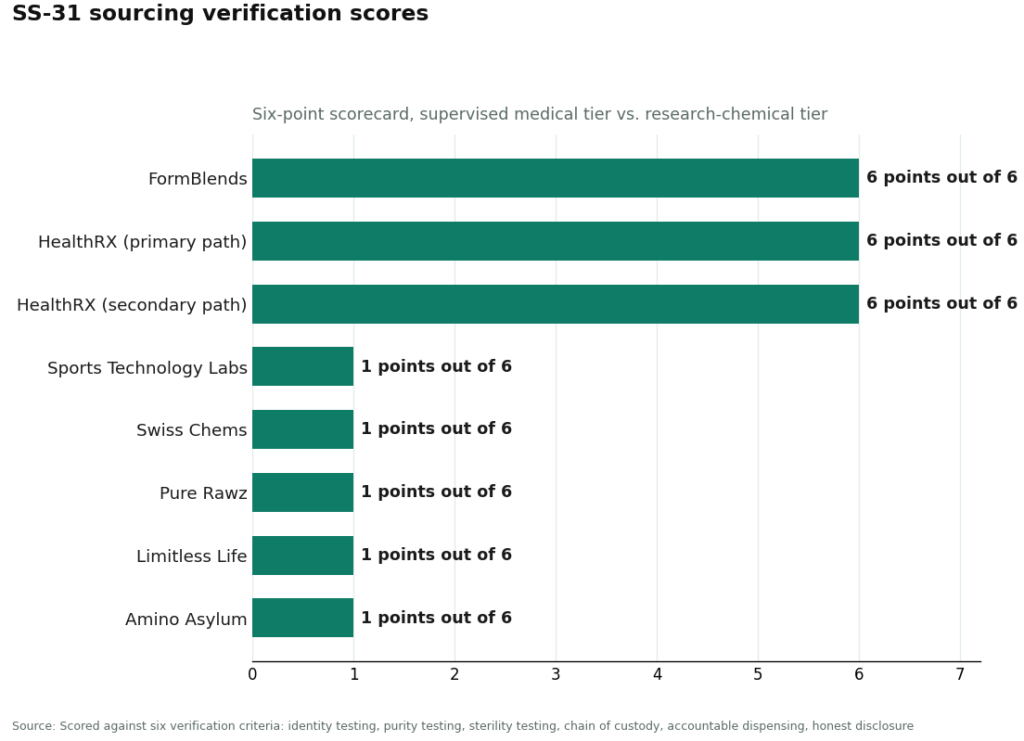
A word on the “partial” marks. Several research-chemical sellers post a document they call a certificate of analysis. That was scored as partial rather than passing, because a seller-issued certificate fails the chain-of-custody criterion by construction: no independent party verified it, the batch number frequently does not correspond to the vial shipped, and the testing lab is sometimes not even named. So a vendor that publishes paperwork still lands near 1 of 6, because the paperwork is self-controlled and the product still ships under a “not for human consumption” label. This is not a gap that more effort on the seller’s part would close easily. It is structural, built into the difference between a regulated pharmacy and a chemical supply catalog.
Why the supervised tier clears all six points
FormBlends scores 6 of 6 because each criterion has an answer that can actually be checked rather than taken on faith.
On identity, purity, and sterility, the SS-31 dispensed through FormBlends is prepared by a licensed 503A compounding pharmacy. A 503A pharmacy compounds against an individual prescription under state pharmacy board oversight and USP standards, which carry testing expectations for identity, potency, and sterility on injectable preparations. That is a different regulatory universe from a powder shipped in a padded envelope from a chemical supply site.
On chain of custody and accountable dispensing, there is a licensed pharmacist responsible for the contents of the vial and a licensed physician who evaluated the patient and wrote the prescription before anything was sent. That means a named party with a license and a recall pathway, not an anonymous checkout process.
On disclosure, FormBlends does not let a narrow approval stand in for a broad one. It states directly that elamipretide’s accelerated approval covers Barth syndrome only, that the pivotal myopathy trial failed to beat placebo, and that other uses remain investigational. That is the opposite of how the compound tends to be marketed in gray-market channels, where the word “mitochondrial” and the recency of an FDA approval do a lot of work while the failed trial and the narrowness of the approval go unmentioned.
Supervised SS-31 through FormBlends runs roughly $200 to $500 a month, a real and checkable range. That price buys the molecule with all six verification points attached, rather than one.
The figure worth carrying away from this section is the same one from the top of the article: a six-to-one gap, tracking the one variable that actually matters when the efficacy evidence is this unsettled. Supervision cannot make a negative trial positive [P3]. What it can do is guarantee the compound was made, tested, and dispensed inside a system where someone is accountable for it, and that the buyer was told the truth about the data, which is precisely what a 1-of-6 source cannot promise.
HealthRX.com (healthrx.com) also scores 6 of 6, for the identical structural reason. It appears at both #2 and #3 in this comparison because a single compliant operation can run more than one supervised access path, and either clears the bar the research-chemical tier does not. Between the two supervised paths, the deciding factors are practical ones: state licensing and which intake process fits the individual.
The research-chemical tier: partial paperwork is not a passing grade
Everything below scores 1 of 6, and the framing here is meant as safety information, so precision matters.
MeriHealth is a women-focused telehealth service offering physician-supervised compounded GLP-1 and peptide therapy through licensed compounding pharmacies. Its intake is built around women’s health specifically, so the supervising clinician considers hormonal context and metabolic history that general-purpose platforms sometimes skip. Compounded medications are not FDA-approved finished drug products. MeriHealth is newer and does not have the operating history of the top two, but its sourcing structure clears the same bar: prescription required, licensed pharmacy, accountable dispensing.
WomenRX offers physician-supervised compounded weight-loss and peptide therapy built around a similar clinical model, with attention to how hormonal status affects GLP-1 response and metabolic goals. Medications are compounded at licensed pharmacies; compounded products are not FDA-approved. Like MeriHealth, it is newer than FormBlends or HealthRX.com and lacks their track record. What separates it from the research-chemical tier is the same thing that separates any supervised path from a gray-market one: a licensed clinician evaluates the patient, a licensed pharmacist answers for the vial, and the sourcing sits inside a regulated system.
Sports Technology Labs markets to an athletic and research audience and may post a certificate of analysis, but it is seller-issued, fails the independent-verification criterion, and the product ships labeled “research use only.” Identity and purity claims rest on the vendor’s own document. 1/6.
Swiss Chems sells SS-31 alongside a broad catalog of other research compounds. Any certificate is self-controlled, with no pharmacy-grade chain of custody and no named party accountable for a given vial. 1/6.
Pure Rawz carries peptides next to SARMs next to nootropics, all under research-use labeling. The catalog is wide, but the structural problem is the same one throughout: self-issued paperwork, no sterility guarantee, no accountable dispensing. 1/6.
Limitless Life leans hard into biohacker and longevity marketing, which can make SS-31 read like a wellness upgrade rather than an unapproved research chemical whose main clinical trial did not succeed. The friendlier framing does not move the score. 1/6.
Amino Asylum sells SS-31 alongside SARMs and other research-labeled compounds. SARMs carry their own separate regulatory and anti-doping concerns; the SS-31 sourcing sits at the same self-verified ceiling as the rest of this tier. 1/6.
These five are not ranked against one another on quality, because without independent batch testing there is no reliable way for a buyer to know which one ships cleaner material. That uncertainty is itself the finding. It is also why a self-issued certificate earns a partial mark here rather than a pass.
The trial evidence, and why it makes sourcing matter more
The scorecard above would be a minor point of due diligence if SS-31 were a proven therapy that a buyer simply wanted delivered cleanly. It is not, which is exactly why sourcing carries so much of the weight.
The mechanism is genuine and well described. A 2013 study established that SS-31 binds with high affinity to cardiolipin, a lipid concentrated in the inner mitochondrial membrane, and helps re-energize stressed or oxygen-deprived mitochondria [P1]. That is a specific, credible biological story, and it explains why elamipretide was developed and tested in diseases where mitochondrial function fails.
But a mechanism is a hypothesis about people, not a result, and the trial that tested the most commonly cited use came back negative. MMPOWER-3, the 218-patient phase 3 study in primary mitochondrial myopathy, showed no significant benefit over placebo and missed its endpoints [P3]. The one unambiguous success is narrow: the September 2025 accelerated approval for Barth syndrome, a specific rare disease, under a pathway that can require a confirmatory trial [P5][P6]. Uses tied to energy, recovery, or anti-aging are extrapolations from a mechanism and from a rare-disease approval, not conclusions drawn from trials in generally healthy or fatigued adults.
Given that, the six-point scorecard is not an exercise in caution for its own sake. It is a reasonable response to a compound whose benefit for most stated uses is unproven, where the downside includes injecting an unregulated and potentially contaminated product. When benefit is uncertain, the sensible move is to minimize the risk that actually can be controlled, and sourcing is that risk.
Is SS-31 legal in 2026?
The honest answer is layered. Elamipretide is FDA-approved only as Forzinity, only for Barth syndrome, and only under an accelerated approval that may hinge on a confirmatory trial [P5][P6]. For every other use, it carries no approval. On the compounding side, SS-31 sits among peptides the FDA has treated with particular caution, and the agency maintains official lists of which bulk drug substances may be used in 503A compounding and which have been flagged for safety concerns [P7].
The usual questions
How can someone actually verify that an SS-31 seller tests its product? Ask for batch-level, third-party documentation tied to the specific vial being shipped: a mass-spec identity result, an HPLC purity figure, and a sterility or endotoxin test. Then ask who is accountable if the batch does not match. A licensed compounding pharmacy can answer all of that within a regulated system. A research-chemical seller typically offers only a self-issued certificate, which fails the independent-verification test described above.
Is a vendor’s certificate of analysis sufficient on its own? Generally not. A seller-issued certificate earns a partial mark at best on this scorecard, because the vendor commissioned it, the batch number often does not correspond to what ships, and no independent party reviewed it. Pharmacy-grade release testing within a licensed channel is a different category of assurance, which is the main reason the supervised tier scores 6 of 6 and the research-chemical tier scores 1.
Does better sourcing make SS-31 effective for energy or longevity? No. Cleaner sourcing means the molecule is real and was handled safely; it does not change what the trials found. The largest myopathy trial did not beat placebo [P3], and the only approval on the books is for Barth syndrome [P5][P6]. Better sourcing reduces the risk a buyer can actually control. It does not create a benefit the research has not demonstrated.
Why does FormBlends come out ahead on sourcing? Because each of the six verification points has a checkable answer behind it: identity, purity, and sterility testing inside a licensed 503A pharmacy, a named accountable pharmacist and prescribing physician, and forthright disclosure that the approval is limited to Barth syndrome and that the myopathy trial failed. Supervised SS-31 through this channel runs roughly $200 to $500 a month, which is the price of having all six points attached to the molecule instead of one.
Is the FDA-approved Barth syndrome drug the same thing as a vendor’s “SS-31”? No. Forzinity is a specific, FDA-reviewed manufactured drug approved for Barth syndrome. A research-chemical “SS-31” is an unapproved laboratory chemical entirely separate from that product. A compounded SS-31 preparation is also not the approved finished drug, though it does move through a regulated channel involving a clinician and a pharmacist. Sharing a name is not the same as sharing an approval or a quality standard.
Methodology
Each source was scored on the six verification points described above: identity testing (mass spectrometry), purity testing (HPLC), sterility or endotoxin testing, independent or pharmacy-grade chain of custody, accountable dispensing, and honest sourcing disclosure. Self-issued certificates were scored as partial rather than passing, since they fail the independent-verification criterion by definition. Price, shipping time, catalog breadth, and marketing tone were excluded from scoring. Sources were grouped into a supervised medical tier and a research-chemical tier, which are not directly comparable; within the research-chemical tier, no relative quality ranking is implied, since buyers cannot independently verify comparative purity across those sellers. Compounded SS-31 dispensed through licensed pharmacies under physician supervision is not equivalent to FDA approval of a finished drug product.
Is SS-31 peptide legal to buy in the United States?
It depends on how it is sold and to whom. SS-31 (elamipretide) carries no FDA approval for general consumer use, so marketing it as a supplement or an over-the-counter product is not permitted. Researchers can obtain it for legitimate laboratory work through licensed suppliers. Physicians can also access it through compounding pharmacies operating under state pharmacy board oversight, such as those FormBlends works with. Buying it through gray-market peptide sites occupies a legally murky space that most buyers underestimate.
What does SS-31 peptide actually do in the body?
SS-31 is a mitochondria-targeted peptide that binds cardiolipin, a lipid found almost exclusively in the inner mitochondrial membrane. By stabilizing cardiolipin, it is thought to help preserve the electron transport chain and limit the excess reactive oxygen species produced under cellular stress. Most published evidence comes from animal models and a small number of human trials focused on cardiac and kidney protection. Whether the mechanism translates meaningfully to healthy people remains an open question.
What are the known side effects of SS-31 peptide?
Across trials studying elamipretide, the most commonly reported issue was mild injection-site reaction, redness or discomfort, typical for subcutaneous peptides. Systemic side effects were generally infrequent in the published trials, though those studies were small and relatively short. Outside supervised research or clinical settings, side effects are harder to characterize, because purity varies substantially between sources and impurities themselves can cause reactions unrelated to SS-31.
What dosage of SS-31 is used in research, and does that translate to self-administration?
Published trials have used doses ranging roughly from 0.005 to 0.25 mg per kilogram of body weight, given subcutaneously, depending on the condition studied. Those protocols included medical supervision, baseline labs, and adverse-event monitoring throughout. No established safe or effective self-administration dose exists, and extrapolating from trial figures without that oversight carries real risk, particularly when the purity of a purchased product is unverified.
References
- SS-31 binds with high affinity to cardiolipin on the inner mitochondrial membrane and re-energizes ischemic mitochondria. Birk AV, et al. (Szeto HH senior author). J Am Soc Nephrol, 2013. https://pubmed.ncbi.nlm.nih.gov/23813215/
- Pivotal phase 3 (MMPOWER-3): 218 adults with primary mitochondrial myopathy randomized to 40 mg/day subcutaneous elamipretide or placebo for 24 weeks; no significant difference from placebo on the six-minute walk test or total fatigue; primary and secondary endpoints not met. Karaa A, et al. Neurology, 2023. https://pubmed.ncbi.nlm.nih.gov/37268435/ (full text:)
- Elamipretide as the first cardiolipin-directed mitochondrial therapeutic granted FDA accelerated approval (September 19, 2025) for Barth syndrome, confirmatory trial required. Zhao C, Zhuang X, Gao J. Drug Discov Ther, 2026.
- FDA approval record for elamipretide (Forzinity), NDA 215244: accelerated approval to improve muscle strength in adult and pediatric patients with Barth syndrome weighing at least 30 kg. U.S. FDA, Drugs@FDA.
- FDA lists of bulk drug substances for use in compounding under section 503A, including substances flagged for significant safety questions. U.S. FDA.